

Why a 3-Day Feature Takes 7 Weeks to Ship
The Decision Latency Trap: Why your enterprise engineering team isn’t actually slow.
When a major software initiative is trailing behind schedule, the post-mortem almost always lands on capacity:
“We need three more senior full-stack developers.”
“Our engineering velocity took a hit during the cloud migration.”
“We’re evaluating an AI-assisted IDE layer to accelerate sprint delivery.”
It’s a comfortable diagnosis because it treats software delivery like an assembly line: add more hands or grease the conveyor belt, and products will roll off the line faster.
The reality is, it’s rarely a capacity issue. When we audit organizational delivery through our Operational Velocity Index (OVI), we consistently find that engineering teams aren’t writing code slowly.
They’re waiting.
They’re waiting for permissions, waiting for architectural approvals, waiting for compliance reviews, and waiting for stakeholders to settle on what they actually want. That friction point is decision latency, the quietest, most expensive productivity sink in modern enterprise IT.
Sprint Velocity vs. Decision Latency
| Phase | Time Spent Active | Time Spent Waiting | Real Friction Source |
|---|---|---|---|
| Scoping & Requirements | 4 hours (active drafting) | 12 days | Back-and-forth email chains, conflicting stakeholder priorities. |
| Architecture Sign-Off | 2 hours (review meeting) | 9 days | Bi-weekly review board schedule; missed agenda cutoff. |
| Engineering Build | 24 hours (active coding) | 0 days | Developers work uninhibited; high sprint velocity. |
| Security & Governance | 3 hours (static scanning) | 8 days | Compliance review happens post-build instead of integrated into sprint kickoff. |
| Production Deployment | 30 minutes (pipeline run) | 6 days | Multi-department change-advisory board approval window. |
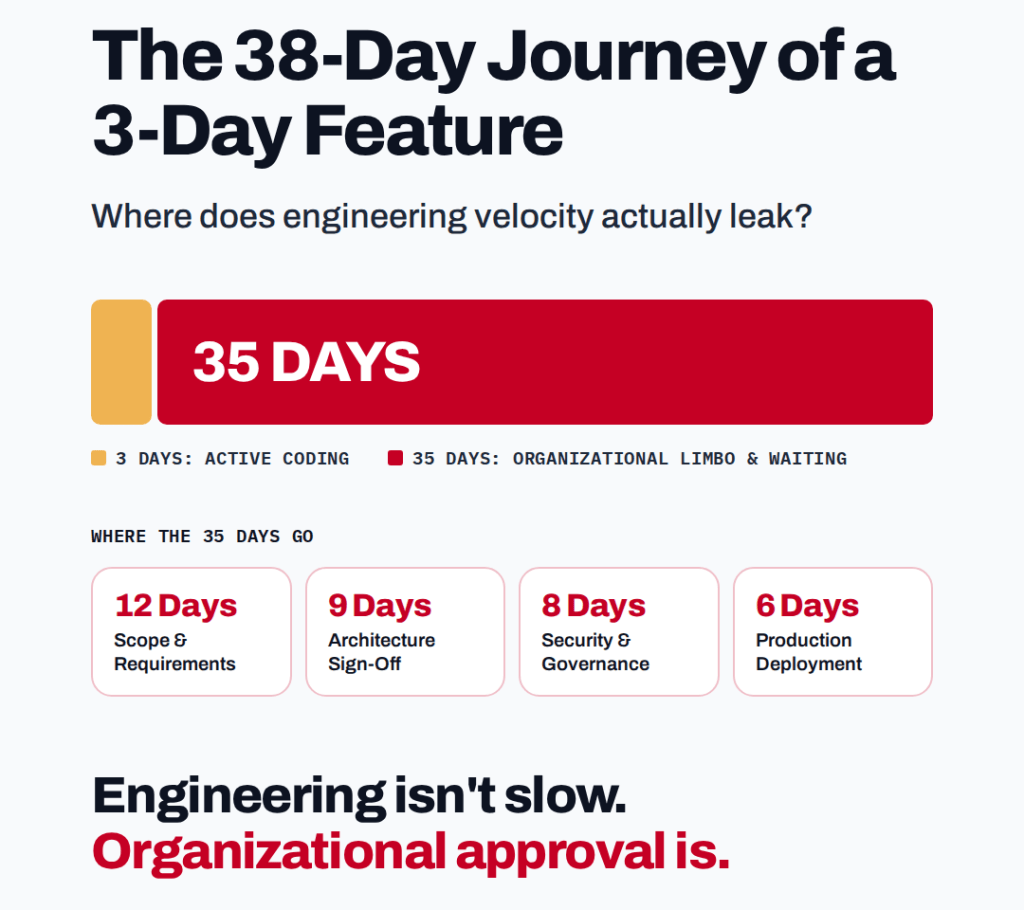
The hands-on engineering effort took roughly three full working days. The organizational journey took nearly seven weeks.
Throwing five more senior engineers into that pipeline doesn’t make the feature arrive five weeks sooner. It just ensures five expensive specialists spend more time context-switching between blocked tasks while waiting on sign-offs.
The Three Hallmarks of Latency-Strangled Organizations
Decision latency thrives where operational architecture is unaligned with modern cloud tooling. It typically takes three distinct forms:
1. The Committee Approval Funnel
In many traditional enterprises, architectural decisions and technology selections run through centralized governance councils. While risk mitigation is essential, councils that meet on fixed cadences introduce artificial batch processing into an agile environment. If a simple API schema change misses the meeting cutoff, the dependent microservice sits dormant for two weeks. That isn’t technical discipline; it’s an administrative bottleneck masquerading as governance.
2. The Late-Stage Compliance Ambush
When security, compliance, and accessibility aren’t built directly into the delivery pipeline, they inevitably show up at the eleventh hour. A development team spends six weeks building out a customer-facing workflow, only to have legal or accessibility counsel flag foundational UX and data-handling flaws two days before the scheduled release. Remediating these issues after production assembly can cost up to ten times more than addressing them during discovery, stalling the entire product roadmap while developers unpick finished architecture.
3. Diffuse Ownership and the “Consensus Trap”
When accountability belongs to a committee rather than a clear product owner, decisions stall out of defensive self-preservation. Everyone wants to review the proposal; no one wants to take responsibility for greenlighting it. The result is the endless loop where minor implementation details receive five rounds of revisions because consensus is prioritized over momentum.
Reclaiming Velocity: What Needs to Change
Fixing this problem doesn’t require tearing down your engineering department or buying another monitoring tool. It requires treating operational decisions as an architectural pipeline with strict service-level agreements (SLAs).
- Shift Governance Left: Security protocols, accessibility standards, and cloud architecture guardrails should be codified directly into your CI/CD pipelines and deployment templates. In typical legacy delivery cycles, the vast majority of project lead time isn’t spent building; it’s spent waiting.
- Measure Cycle Time, Not Just Story Points: Track the elapsed duration from an idea’s initial creation to its live production deployment (Lead Time for Changes). When you expose the ratio between active engineering time and idle waiting time, management attention shifts from hiring developers to eliminating handoff delays.
- Decentralize Operational Authority: Push architectural and deployment decisions to the people closest to the execution layer. Centralized committees should define safety boundaries and compliance policies, not micromanage day-to-day implementation details.
The Bottom Line
Velocity is not how hard your developers are typing on their keyboards. It is how fast an idea travels from strategic decision to working software without getting stranded in stakeholder limbo.
If you want to ship software faster, start by timing how long a decision takes to get made inside your building. The codebase is rarely the place where the clock is running out.
Find out where your delivery pipeline is actually blocked.
Adding engineering capacity won’t fix a 38-day cycle when 35 of those days belong to queues, handoffs, and review boards. Measure your Demand Responsiveness, Process Elasticity, and Governance Velocity against modern enterprise delivery standards.
Or read the full framework: Explore the Operational Velocity Index (OVI) →