Lift-and-Shift Is Not a Strategy: Designing Cloud Architecture Around How Your Business Actually Works
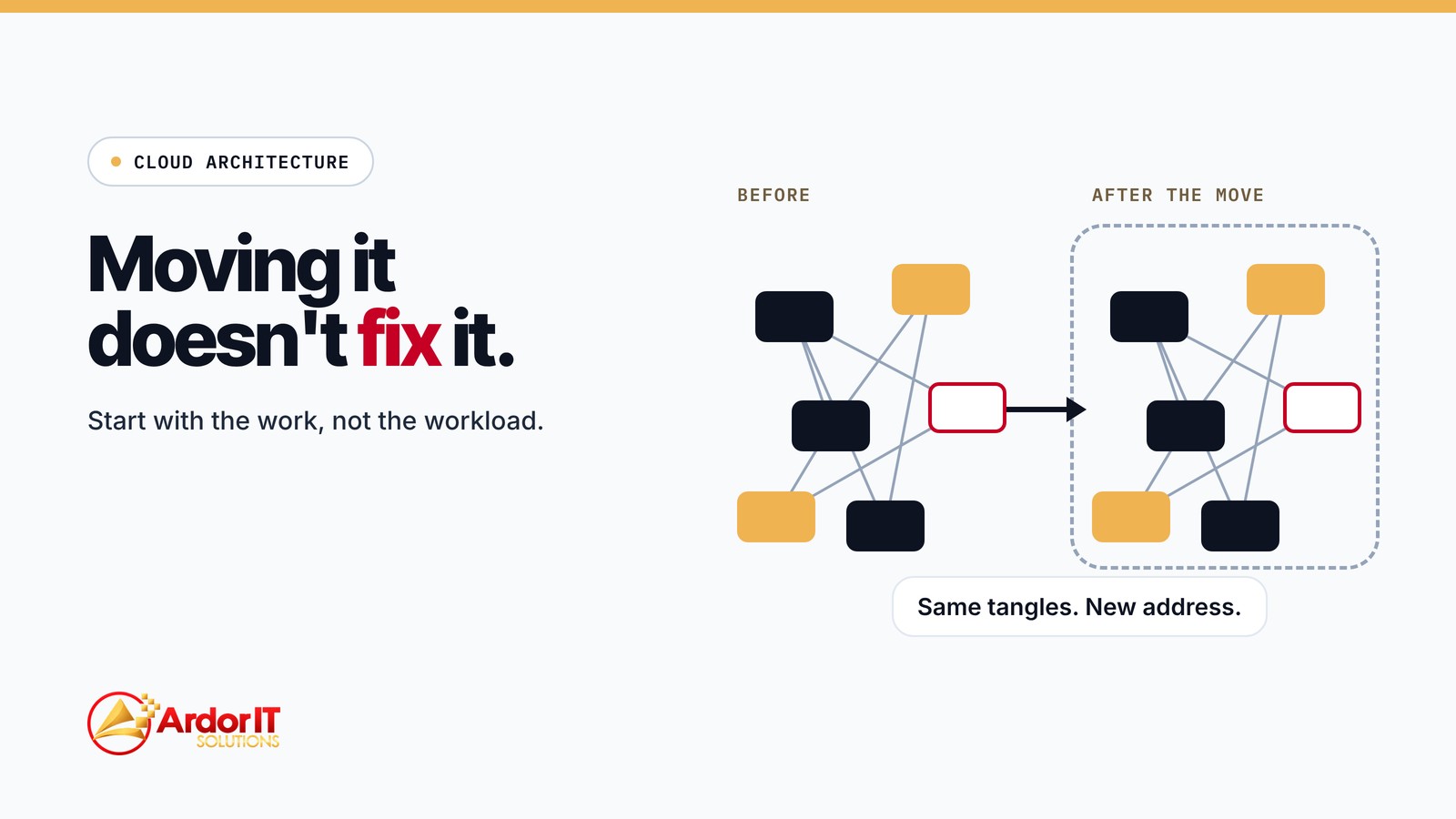
A move to the cloud can be the right decision. It can help an organization leave aging infrastructure, support a changing application footprint, or simplify an infrastructure transition. But moving software to a different environment doesn’t automatically change how that software works, how people use it, or how often it needs attention.
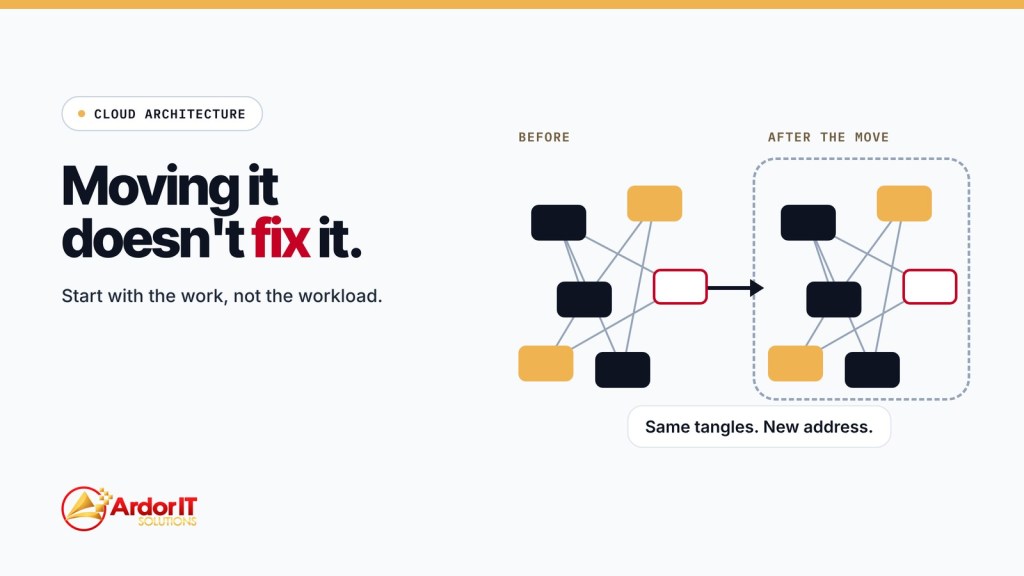
That’s the problem with treating lift-and-shift as a strategy. You can move every server successfully and still arrive with the same slow handoffs, tangled dependencies, fragile integrations, and unclear ownership. The hosting location changed. The work did not.
The more useful question comes first: What does this application need to help the business accomplish, and what’s stopping it today?
A migration method is not a business outcome
Lift-and-shift usually refers to rehosting an application with limited changes to its underlying design. There are legitimate reasons to do that. A deadline may require a fast infrastructure exit. The current application may be stable enough that redesign would add needless disruption. A staged approach may provide a sensible transition point.
The mistake is assuming that rehosting, by itself, delivers modernization. It may leave the application with the same licensing assumptions, database bottlenecks, batch processes, access constraints, and support dependencies. It can also expose new questions about monitoring, security controls, resilience, and operating cost.
None of that means every application needs to be rewritten. It simply means the decision should be explicit rather than accidental.
Start with the work, not the workload
Before discussing hosting options, trace one important process from the first request to the business result. That might be an order becoming an invoice, a service request reaching a field team, or a customer action creating an update in an internal system. Ask:
- Where does the work begin, and what does “done” mean to the people who depend on it?
- Which application, data store, integration, or manual handoff supports each step?
- Where does someone re-enter information, wait for an approval, or repair a mismatch?
- What cannot be interrupted during a transition, and who decides whether the risk is acceptable?
- What outcome would make a change worth the effort: easier support, fewer handoffs, more reliable operations, or a shorter path from request to completion?
These questions don’t assume the application is broken. They establish whether moving it is likely to address the problem the business actually cares about.
Choose the treatment application by application
Once the role of the application is clear, there are several reasonable paths. You might retain it where it runs today, retire functionality that no longer serves a need, rehost a stable workload, replatform selected components, or refactor code where there is a defensible reason to do so.
Those are assessment choices, not a ladder everyone must climb. A modestly changed application may be the responsible answer. An expensive rewrite may be an answer to a problem nobody asked you to solve.
For each candidate application, capture the tradeoffs in a short decision record. Who owns the application? What business process depends on it? What changes are expected? What must remain stable? What has not yet been verified?
Don’t let the migration plan hide the operating plan
A cutover date tells you when something is supposed to move. It doesn’t tell you who will support it afterward. Before approving the plan, confirm the responsibilities that persist after launch:
- Application ownership and the people authorized to change it.
- Security, identity, access, and data-handling requirements.
- Monitoring, incident response, backup, and recovery expectations.
- Dependencies on other applications and business partners.
- The expected operating effort, ongoing costs, and how changes will be assessed.
A successful technical cutover that leaves ownership unresolved has simply moved the confusion to a new location.
Measure what changed for the business
Instead of treating “migrated” as the only success measure, establish a baseline around the work the application supports. How long does a common change take today? How much manual intervention does a standard process require? How often does a support issue prevent someone from completing a task?
Select a small number of measures that are relevant and observable. Compare them after the change. Some will improve, some may stay the same, and others may reveal work that still needs attention. That’s useful information, not a failure of the assessment.
The same discipline applies to application decisions beyond cloud migration. Ardor IT Solutions offers technology solutions including technology consulting, application development, implementation, and support. A useful first conversation should define the application need before choosing any delivery path.
The bottom line
Lift-and-shift can be a tactic. It should never be the answer before the question. Start with the work, document the dependencies, decide what genuinely needs to change, and make ownership explicit. Only then should the hosting decision become the center of the plan.
Bring one application, not a cloud wish list. If you’re weighing a change to a business-critical application, start by defining its purpose, dependencies, and support requirements. Discuss your application challenges with Ardor IT Solutions.