
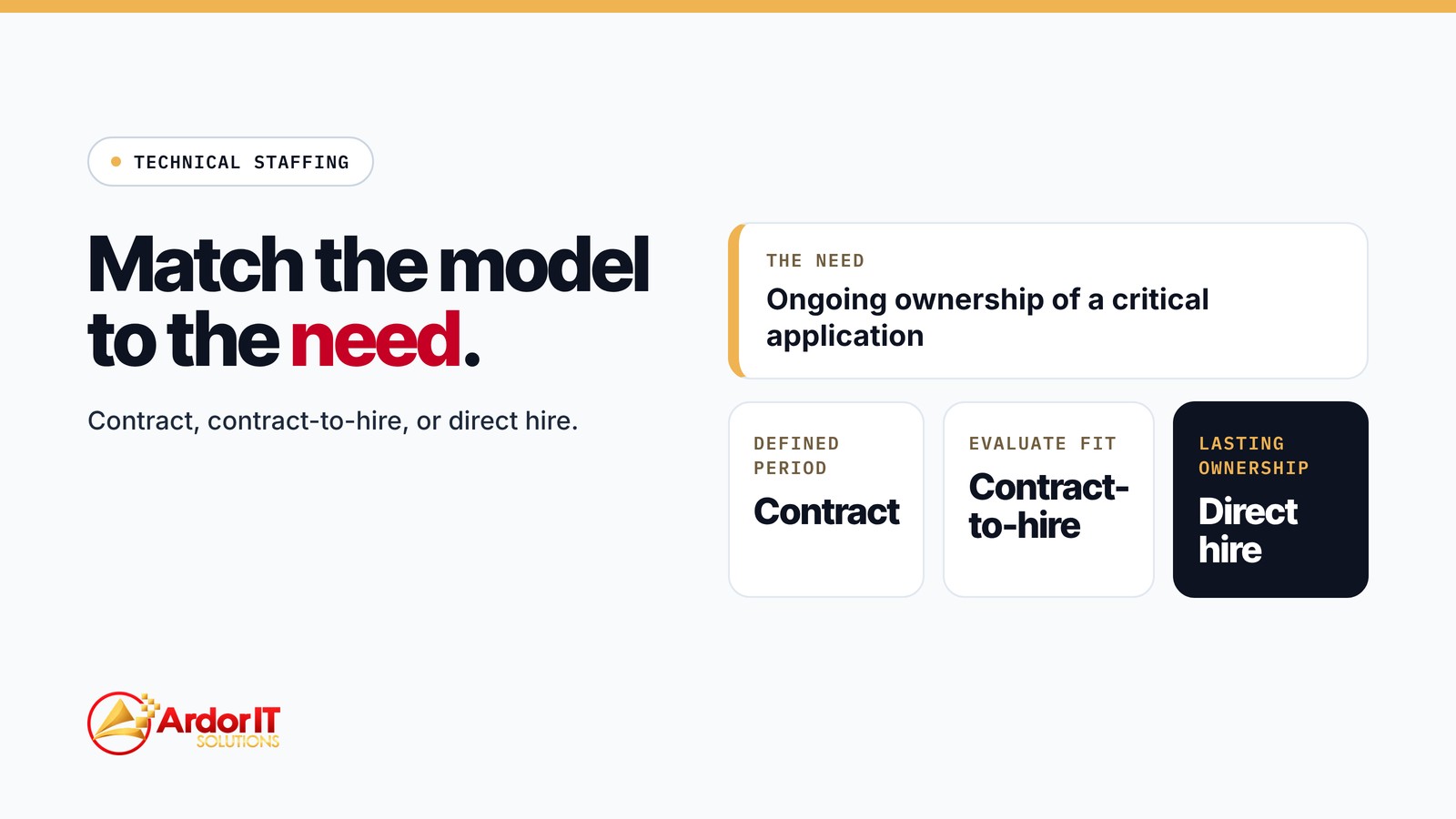
Capacity Without the Hangover: Choosing the Right Technical Staffing Model
A growing engineering backlog often triggers an understandable reaction: we need more people. But the number of open tickets doesn’t tell you what kind of help to bring in, how long you’ll need it, or who should own the work when the immediate pressure passes.
A technical leader might need a specialist for a defined period, a person who can grow into an ongoing role, or a permanent owner for a critical application. Those are different needs. Treating them as the same requisition creates avoidable confusion for the hiring manager, the candidate, and the people who will work alongside them.
The better starting point is simple: What does the work require, and what should be true after this person joins the team?
/image
Start with a useful definition of the job
Before choosing a staffing model, define the responsibility in practical terms. Is the person closing a time-limited gap? Taking ownership of an application? Helping your internal team through a project ramp-up? Building a capability you expect to need next year?
Then distinguish required skills from preferred tools. A long list of technologies isn’t a substitute for describing the results the person will be responsible for. Explain the environment, expected contribution, decision authority, onboarding needs, and how performance will be assessed.
This gives a talent partner something better to work with than an open-ended request for “someone senior who can do everything.”
Contract: investigate a defined need
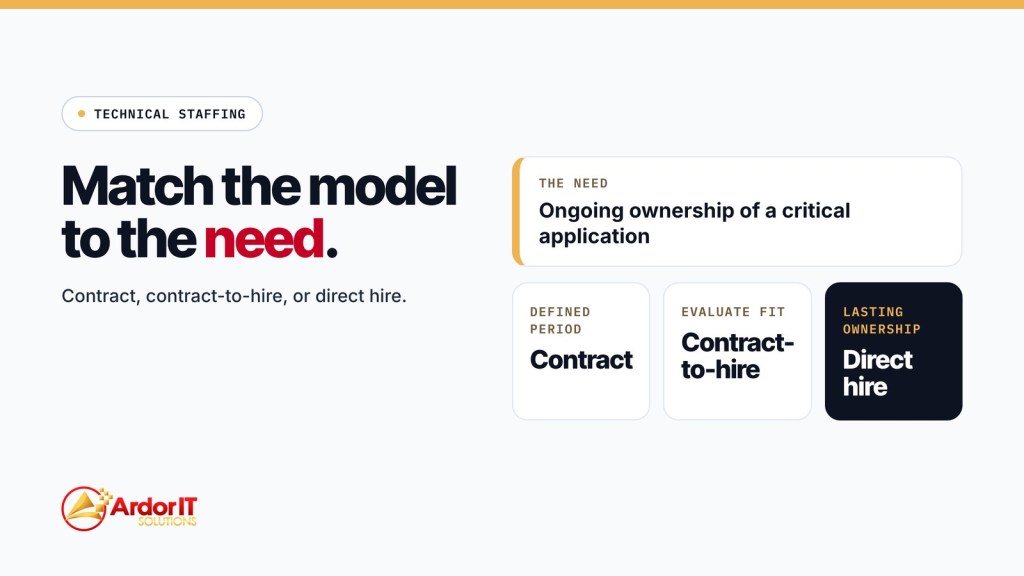
Contract staffing may fit when you have a specific assignment, time-limited capacity requirement, project ramp-up, or specialized skill need. The buyer should know who directs the work, how long the assignment is expected to last, and what completion looks like.
That doesn’t automatically make contract staffing faster or less expensive than hiring, though. Recruiting conditions, the skills required, onboarding, procurement requirements, and the assignment itself all affect the decision.
Ask: Is this a defined period of work, and who will own the outcome while the contractor is here?
Contract-to-hire: evaluate a possible long-term fit
Contract-to-hire can make sense when an organization wants an evaluation period before making a potential permanent hiring decision, subject to agreed terms. The arrangement should give both parties a clear understanding of what success looks like, what they will evaluate, and what would need to happen before any conversion.
A conversion isn’t automatic. Nor is contract-to-hire universally lower risk or a better path for every role. It’s just one available model to consider when the buyer’s goals and the engagement terms support it.
Ask: What would you need to observe during the assignment before considering a permanent offer, and what conversion terms would work for both sides?
Direct hire: build lasting internal ownership
Direct hire is worth considering when the work is ongoing and the organization is ready to support a permanent role. Institutional knowledge, application stewardship, stakeholder relationships, and long-term accountability may matter more than the short-term capacity spike that made the opening visible.
The right permanent hire still depends on a realistic scope, effective onboarding, and the skills the position actually needs. A permanent role isn’t always the right answer to a temporary backlog.
Ask: Does the organization need this capability as an enduring part of the team, and is it prepared to hire and develop that person long term?
Six questions that make the choice easier
- What must the person deliver in the first 90 days and the first six months?
- Is the need temporary, recurring, or expected to become a permanent responsibility?
- Which skills are essential immediately, and which can someone reasonably learn?
- Who will direct the work, manage onboarding, and evaluate outcomes?
- What procurement, security, workforce-program, or conversion requirements apply?
- Who owns the knowledge and the next decision after the initial work is complete?
These questions may point toward one model, or they may expose a need to define the role more clearly before recruiting. Both are useful outcomes.
Watch for two common traps
“We always hire full-time.”
That may be entirely appropriate. If the capability belongs inside the organization for the long term, a permanent hire may be the most sensible choice. But if the need is time-bound, ask whether the business is creating an enduring position to solve a temporary problem.
“Contract is the fastest way out of this.”
Possibly, but speed should be established through the actual hiring requirements and available evidence, not a blanket promise. A highly specialized contract role can still be difficult to fill, and a new contributor still needs context and appropriate access before doing useful work.
The decision isn’t just about filling an empty seat. It’s about putting the right responsibility, duration, and support around the work.
Bring a real role to the conversation
Ardor IT Solutions supports technical hiring through contract, contract-to-hire, and direct hire. Those confirmed engagement models create room to discuss what you actually need, without assuming the same answer fits every organization.
Explore the established options through Ardor IT Solutions’ Professional & Talent Solutions page.
The bottom line
A backlog can signal a capacity gap, a missing capability, a process delay, or a combination of problems. Adding people is useful when additional capacity or skills are the right response. Choosing the appropriate staffing model begins with understanding that distinction.
Start with one hard-to-fill technical role. Write down the outcome, required skills, expected duration, and whether the need is likely to be permanent. Then compare the available hiring approaches with Ardor IT Solutions.