
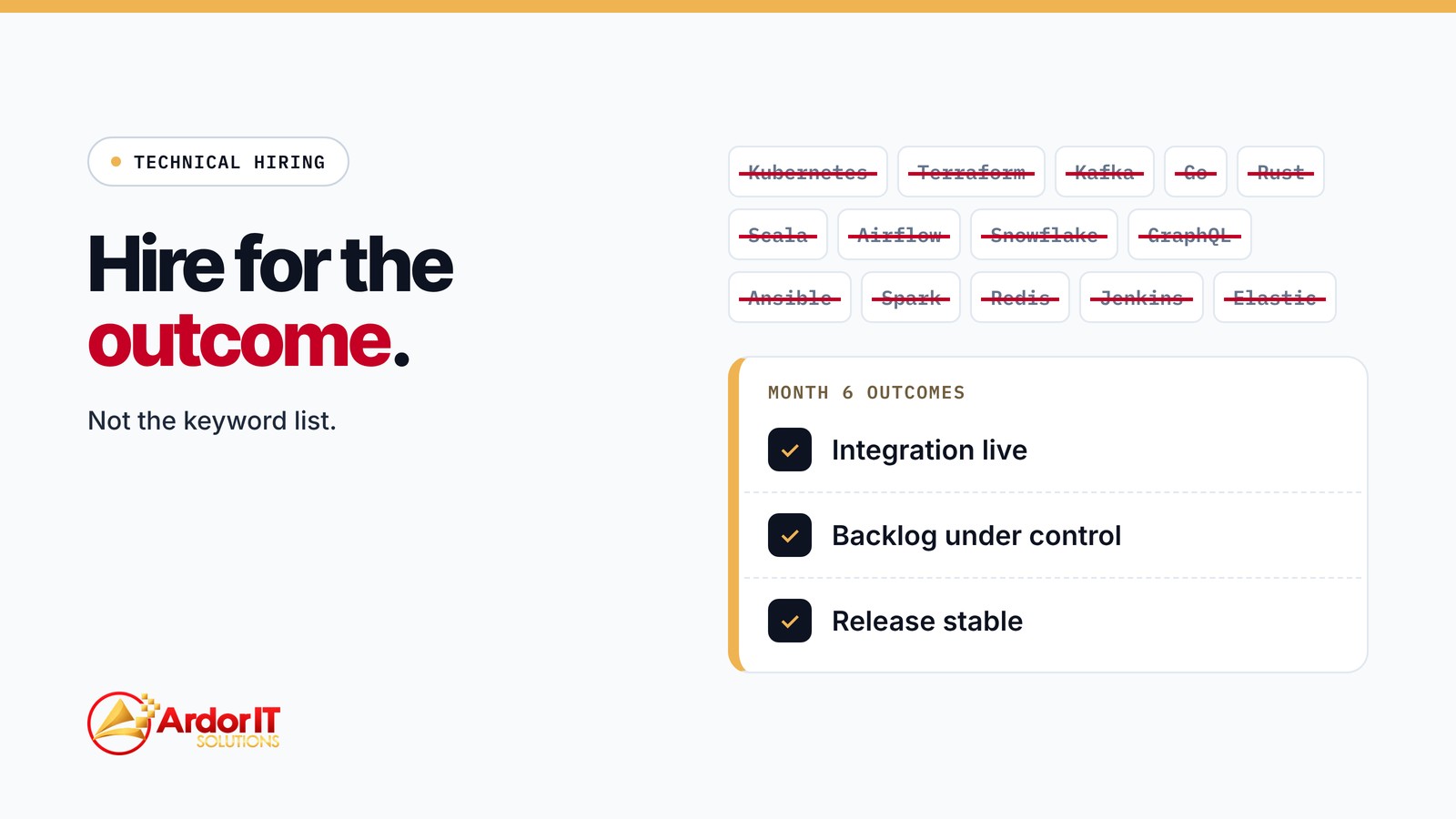
Hire for the Outcome: Rewriting Technical Job Descriptions That Attract the Right People
Ever read a job description that asks for 14 tools and never says what the job actually is?
It happens for understandable reasons. A hiring manager is busy, the last posting is easy to copy, and every new requirement feels like insurance. The list grows. The purpose of the role gets harder to find.
A long keyword list feels thorough. In practice, it filters for people who match the vocabulary, and it can screen out people who could do the work. The better starting point is a different question: What should this person have delivered six months from now?
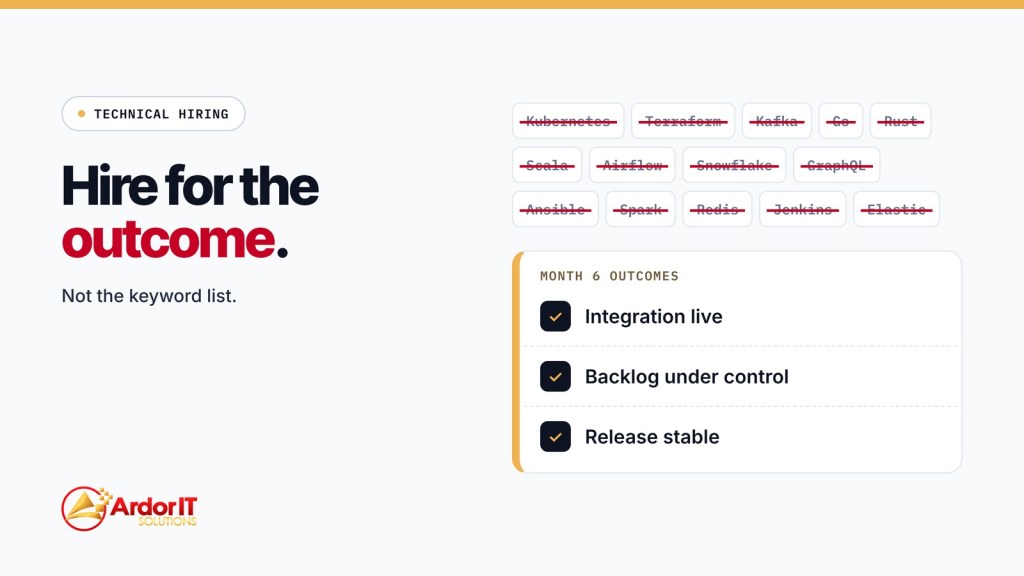
The keyword list is a guess
Most tool lists are built from the current stack, the last person in the seat, and a few technologies someone hopes to adopt. Some of those skills matter on day one. Others the role may never use.
Look back at your last technical posting. How many of the “must-have” skills did the person who filled the role actually use in their first 90 days? If the answer is “fewer than we listed,” the posting was describing the team’s environment, not the job.
That isn’t a small problem. Every unnecessary requirement narrows the pool, and the candidates who do apply learn very little about what success looks like.
Start with what has to be true in six months
Before you write a single requirement, write down the outcomes. What will this person have built, fixed, or kept running? Keep it concrete: an integration that’s live, a backlog that’s under control, a platform that’s stable through the next release, a reporting process that no longer depends on one person.
Three to five outcomes is usually enough. If you can’t name them, the role may not be ready to post, and that’s worth knowing before anyone spends time recruiting.
Ask: If this hire goes well, what will be different six months from now, and who will notice?
Then work backward to the skills
With the outcomes in hand, sort every skill into one of two groups: what someone needs on day one, and what a capable person can learn on the job. Most job descriptions mix the two, which is how a role that needs strong application support experience ends up requiring expertise in a dozen tools the team barely uses.
Day-one skills are the ones the work can’t start without. Learnable skills usually include your internal tools, your stack’s quirks, and your team’s processes. Naming the difference tells candidates where to focus and helps recruiters find people with the right foundation.
Ask: Which skills would stop this person from contributing in the first month, and which would they pick up anyway?
Screen for the work, not the vocabulary
A résumé shows where someone has been. It doesn’t always show how they work. A short, representative, job-relevant work sample often tells you more than a list of tools: a realistic scenario, a piece of code to review, a support issue to talk through, or a design decision to explain.
Keep the exercise brief and respectful of candidates’ time, and evaluate every response the same way. Decide in advance what a strong answer includes, who reviews it, and how the team will compare candidates. A consistent approach is fairer to candidates and easier for hiring managers to defend.
Ask: What could a candidate show us in under an hour that would tell us whether they can deliver the performance we need?
Match the engagement model to the work
Once the outcomes and skills are clear, the staffing model usually gets easier to choose. A defined, time-limited assignment may suit contract staffing. An evaluation period before a possible permanent decision may suit contract-to-hire. Ongoing ownership of a critical application may call for a direct hire. None of them is automatically faster, cheaper, or lower risk; the work decides. Our guide to choosing a technical staffing model goes deeper.
Put it on one page
Before the next posting goes live, try a one-page outcome brief. It gives the hiring manager, the recruiter, and any staffing partner the same picture of the role:
- Purpose. One sentence on why the role exists now.
- Six-month outcomes. Three to five results, in plain language.
- Day-one skills. The few the work can’t start without.
- Learnable skills. What a capable person can pick up on the job.
- Environment. The team, the systems, and who directs the work.
- Evaluation. The work sample, who reviews it, and what a strong response includes.
- Engagement model. Contract, contract-to-hire, or direct hire, and why.
Write the job description from the brief, not the other way around. The posting gets shorter, clearer, and more useful to the people you actually want to reach.
The bottom line
Define the outcome first, and the right requirements will follow. The role becomes easier to explain, easier to screen for, and easier to fill with someone who can do the work.
Start with one open technical role. Write down what it must deliver in six months and which skills it truly needs on day one. Then talk with our talent team about the role and which engagement model fits.