Put AI Inside the Work: Start With One Workflow, Not a Platform
“We need an AI strategy” is a reasonable goal. It’s also a hard place to start.
It’s too big to scope and too vague to measure. Teams spend months comparing platforms and drafting principles while the work that could benefit sits right in front of them: the report someone rebuilds every Monday, the inbox someone sorts every morning, the data someone re-enters every afternoon.
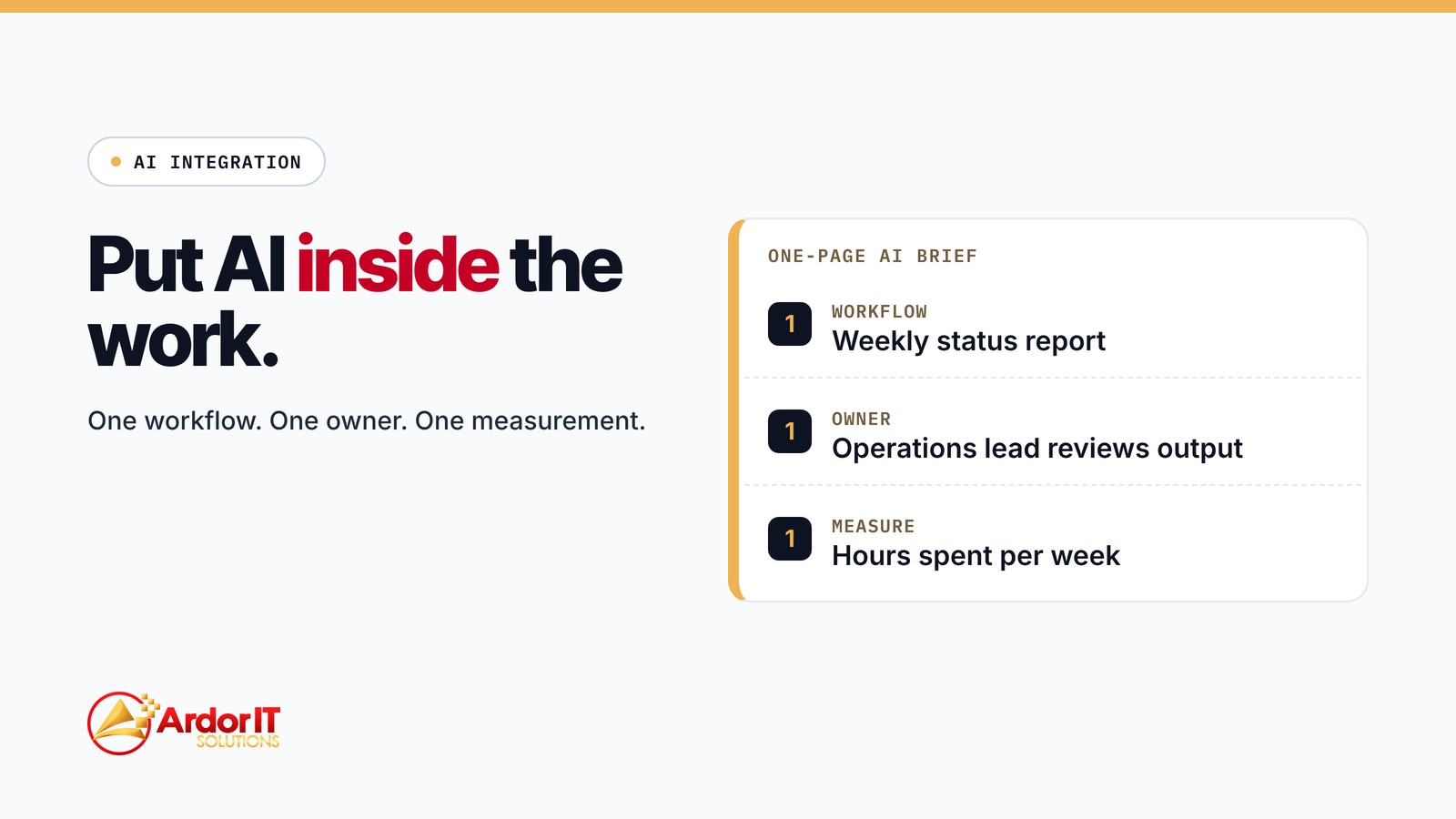
The AI efforts that are easiest to prove usually start small and specific. Put AI inside the work your team already does, one workflow at a time.
Hire for the Outcome: Rewriting Technical Job Descriptions That Attract the Right People
Ever read a job description that asks for 14 tools and never says what the job actually is?
It happens for understandable reasons. A hiring manager is busy, the last posting is easy to copy, and every new requirement feels like insurance. The list grows. The purpose of the role gets harder to find.
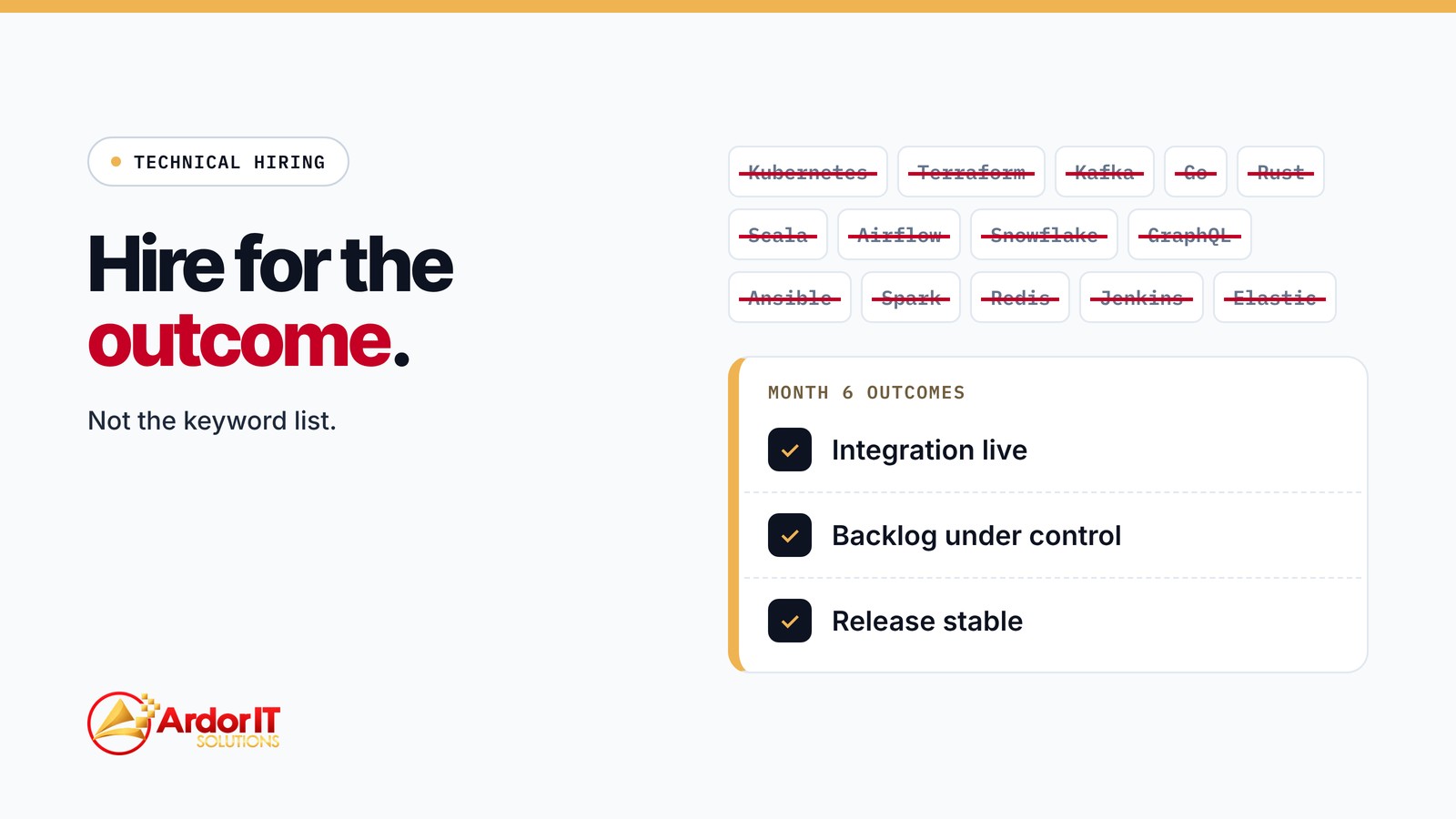
A long keyword list feels thorough. In practice, it filters for people who match the vocabulary, and it can screen out people who could do the work. The better starting point is a different question: What should this person have delivered six months from now?
The keyword list is a guess
Most tool lists are built from the current stack, the last person in the seat, and a few technologies someone hopes to adopt. Some of those skills matter on day one. Others the role may never use.
Look back at your last technical posting. How many of the “must-have” skills did the person who filled the role actually use in their first 90 days? If the answer is “fewer than we listed,” the posting was describing the team’s environment, not the job.
That isn’t a small problem. Every unnecessary requirement narrows the pool, and the candidates who do apply learn very little about what success looks like.
Start with what has to be true in six months
Before you write a single requirement, write down the outcomes. What will this person have built, fixed, or kept running? Keep it concrete: an integration that’s live, a backlog that’s under control, a platform that’s stable through the next release, a reporting process that no longer depends on one person.
Three to five outcomes is usually enough. If you can’t name them, the role may not be ready to post, and that’s worth knowing before anyone spends time recruiting.
Ask: If this hire goes well, what will be different six months from now, and who will notice?
Then work backward to the skills
With the outcomes in hand, sort every skill into one of two groups: what someone needs on day one, and what a capable person can learn on the job. Most job descriptions mix the two, which is how a role that needs strong application support experience ends up requiring expertise in a dozen tools the team barely uses.
Day-one skills are the ones the work can’t start without. Learnable skills usually include your internal tools, your stack’s quirks, and your team’s processes. Naming the difference tells candidates where to focus and helps recruiters find people with the right foundation.
Ask: Which skills would stop this person from contributing in the first month, and which would they pick up anyway?
Screen for the work, not the vocabulary
A résumé shows where someone has been. It doesn’t always show how they work. A short, representative, job-relevant work sample often tells you more than a list of tools: a realistic scenario, a piece of code to review, a support issue to talk through, or a design decision to explain.
Keep the exercise brief and respectful of candidates’ time, and evaluate every response the same way. Decide in advance what a strong answer includes, who reviews it, and how the team will compare candidates. A consistent approach is fairer to candidates and easier for hiring managers to defend.
Ask: What could a candidate show us in under an hour that would tell us whether they can deliver the performance we need?
Match the engagement model to the work
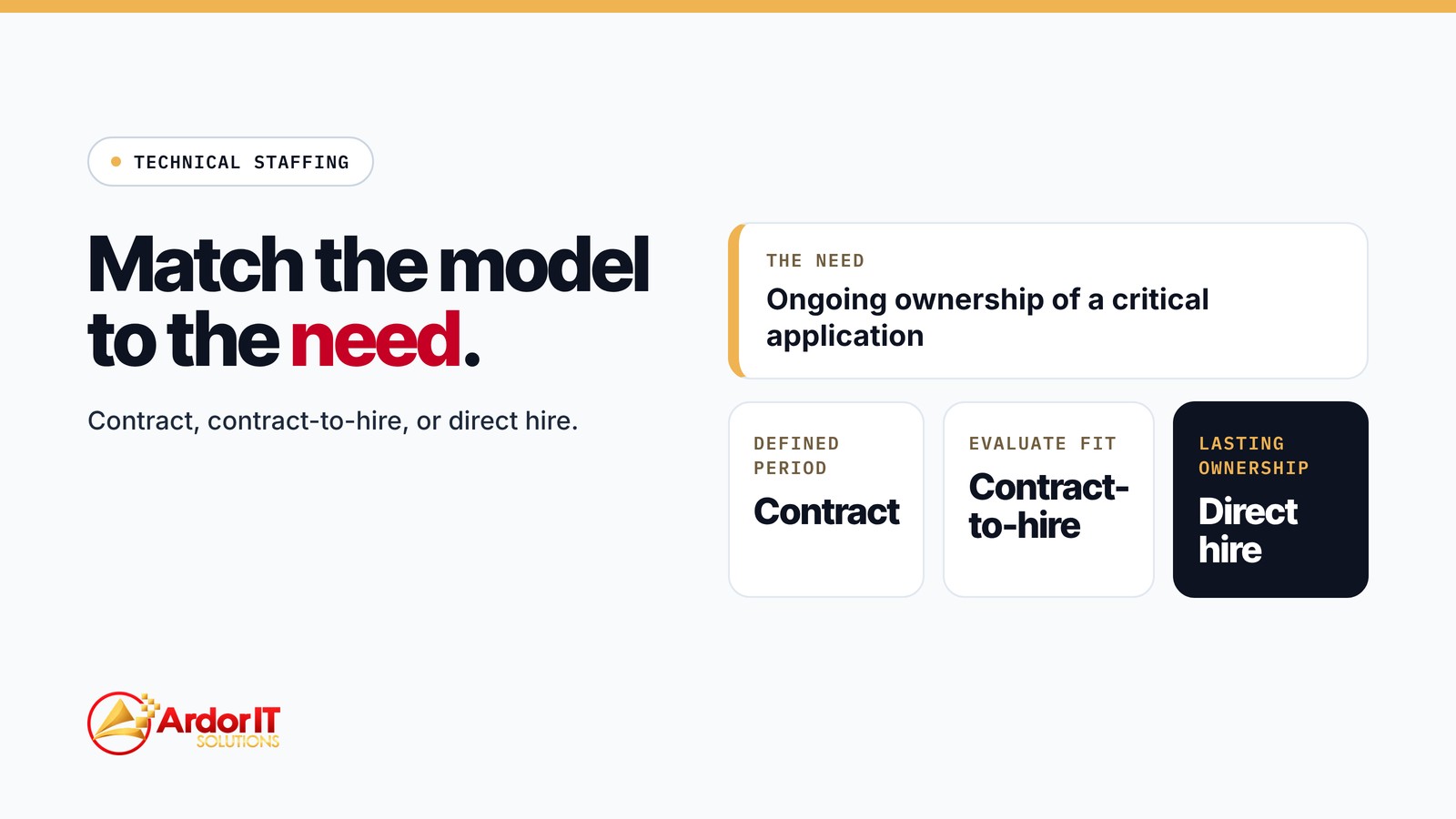
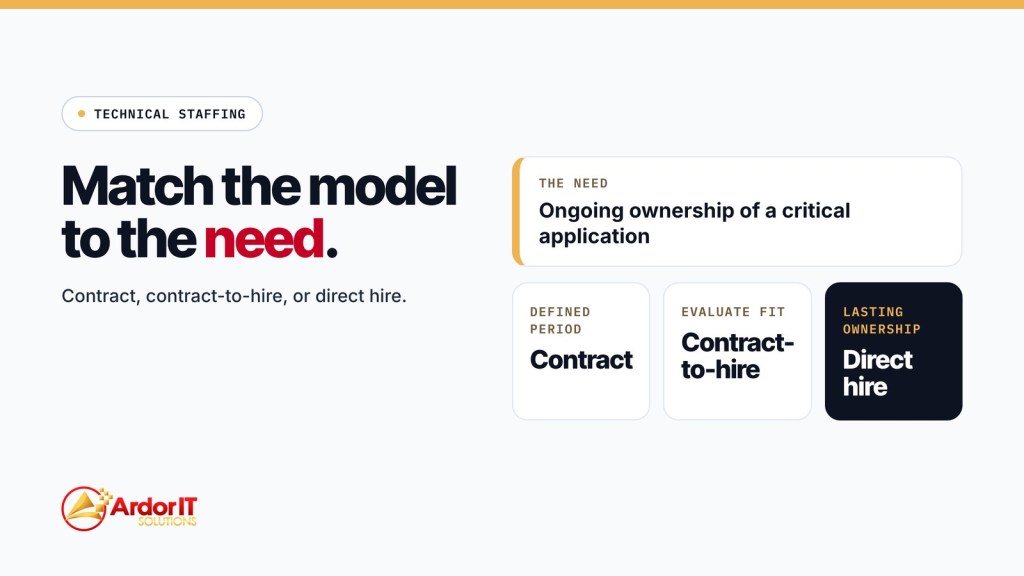
Once the outcomes and skills are clear, the staffing model usually gets easier to choose. A defined, time-limited assignment may suit contract staffing. An evaluation period before a possible permanent decision may suit contract-to-hire. Ongoing ownership of a critical application may call for a direct hire. None of them is automatically faster, cheaper, or lower risk; the work decides. Our guide to choosing a technical staffing model goes deeper.
Put it on one page
Before the next posting goes live, try a one-page outcome brief. It gives the hiring manager, the recruiter, and any staffing partner the same picture of the role:
Purpose. One sentence on why the role exists now.
Six-month outcomes. Three to five results, in plain language.
Day-one skills. The few the work can’t start without.
Learnable skills. What a capable person can pick up on the job.
Environment. The team, the systems, and who directs the work.
Evaluation. The work sample, who reviews it, and what a strong response includes.
Engagement model. Contract, contract-to-hire, or direct hire, and why.
Write the job description from the brief, not the other way around. The posting gets shorter, clearer, and more useful to the people you actually want to reach.
The bottom line
Define the outcome first, and the right requirements will follow. The role becomes easier to explain, easier to screen for, and easier to fill with someone who can do the work.
Start with one open technical role. Write down what it must deliver in six months and which skills it truly needs on day one. Then talk with our talent team about the role and which engagement model fits.
Capacity Without the Hangover: Choosing the Right Technical Staffing Model
A growing engineering backlog often triggers an understandable reaction: we need more people. But the number of open tickets doesn’t tell you what kind of help to bring in, how long you’ll need it, or who should own the work when the immediate pressure passes.
A technical leader might need a specialist for a defined period, a person who can grow into an ongoing role, or a permanent owner for a critical application. Those are different needs. Treating them as the same requisition creates avoidable confusion for the hiring manager, the candidate, and the people who will work alongside them.
The better starting point is simple: What does the work require, and what should be true after this person joins the team?
/image
Start with a useful definition of the job
Before choosing a staffing model, define the responsibility in practical terms. Is the person closing a time-limited gap? Taking ownership of an application? Helping your internal team through a project ramp-up? Building a capability you expect to need next year?
Then distinguish required skills from preferred tools. A long list of technologies isn’t a substitute for describing the results the person will be responsible for. Explain the environment, expected contribution, decision authority, onboarding needs, and how performance will be assessed.
This gives a talent partner something better to work with than an open-ended request for “someone senior who can do everything.”
Contract: investigate a defined need
Contract staffing may fit when you have a specific assignment, time-limited capacity requirement, project ramp-up, or specialized skill need. The buyer should know who directs the work, how long the assignment is expected to last, and what completion looks like.
That doesn’t automatically make contract staffing faster or less expensive than hiring, though. Recruiting conditions, the skills required, onboarding, procurement requirements, and the assignment itself all affect the decision.
Ask: Is this a defined period of work, and who will own the outcome while the contractor is here?
Contract-to-hire: evaluate a possible long-term fit
Contract-to-hire can make sense when an organization wants an evaluation period before making a potential permanent hiring decision, subject to agreed terms. The arrangement should give both parties a clear understanding of what success looks like, what they will evaluate, and what would need to happen before any conversion.
A conversion isn’t automatic. Nor is contract-to-hire universally lower risk or a better path for every role. It’s just one available model to consider when the buyer’s goals and the engagement terms support it.
Ask: What would you need to observe during the assignment before considering a permanent offer, and what conversion terms would work for both sides?
Direct hire: build lasting internal ownership
Direct hire is worth considering when the work is ongoing and the organization is ready to support a permanent role. Institutional knowledge, application stewardship, stakeholder relationships, and long-term accountability may matter more than the short-term capacity spike that made the opening visible.
The right permanent hire still depends on a realistic scope, effective onboarding, and the skills the position actually needs. A permanent role isn’t always the right answer to a temporary backlog.
Ask: Does the organization need this capability as an enduring part of the team, and is it prepared to hire and develop that person long term?
Six questions that make the choice easier
What must the person deliver in the first 90 days and the first six months?
Is the need temporary, recurring, or expected to become a permanent responsibility?
Which skills are essential immediately, and which can someone reasonably learn?
Who will direct the work, manage onboarding, and evaluate outcomes?
What procurement, security, workforce-program, or conversion requirements apply?
Who owns the knowledge and the next decision after the initial work is complete?
These questions may point toward one model, or they may expose a need to define the role more clearly before recruiting. Both are useful outcomes.
Watch for two common traps
“We always hire full-time.”
That may be entirely appropriate. If the capability belongs inside the organization for the long term, a permanent hire may be the most sensible choice. But if the need is time-bound, ask whether the business is creating an enduring position to solve a temporary problem.
“Contract is the fastest way out of this.”
Possibly, but speed should be established through the actual hiring requirements and available evidence, not a blanket promise. A highly specialized contract role can still be difficult to fill, and a new contributor still needs context and appropriate access before doing useful work.
The decision isn’t just about filling an empty seat. It’s about putting the right responsibility, duration, and support around the work.
Bring a real role to the conversation
Ardor IT Solutions supports technical hiring through contract, contract-to-hire, and direct hire. Those confirmed engagement models create room to discuss what you actually need, without assuming the same answer fits every organization.
A backlog can signal a capacity gap, a missing capability, a process delay, or a combination of problems. Adding people is useful when additional capacity or skills are the right response. Choosing the appropriate staffing model begins with understanding that distinction.
Essential cookies enable basic functions and are necessary for the proper function of the website.
Name
Description
Duration
Cookie Preferences
This cookie is used to store the user's cookie consent preferences.
30 days
These cookies are needed for adding comments on this website.
Name
Description
Duration
comment_author
Used to track the user across multiple sessions.
Session
comment_author_email
Used to track the user across multiple sessions.
Session
comment_author_url
Used to track the user across multiple sessions.
Session
Statistics cookies collect information anonymously. This information helps us understand how visitors use our website.
Name
Description
Duration
_wpfuuid
1 year
Jetpack's built-in visitor analytics. It records page views, referring sites, search terms, and outbound link clicks, and also carries the shared visitor-tracking library used by Jetpack Instant Search and WooCommerce Analytics.