
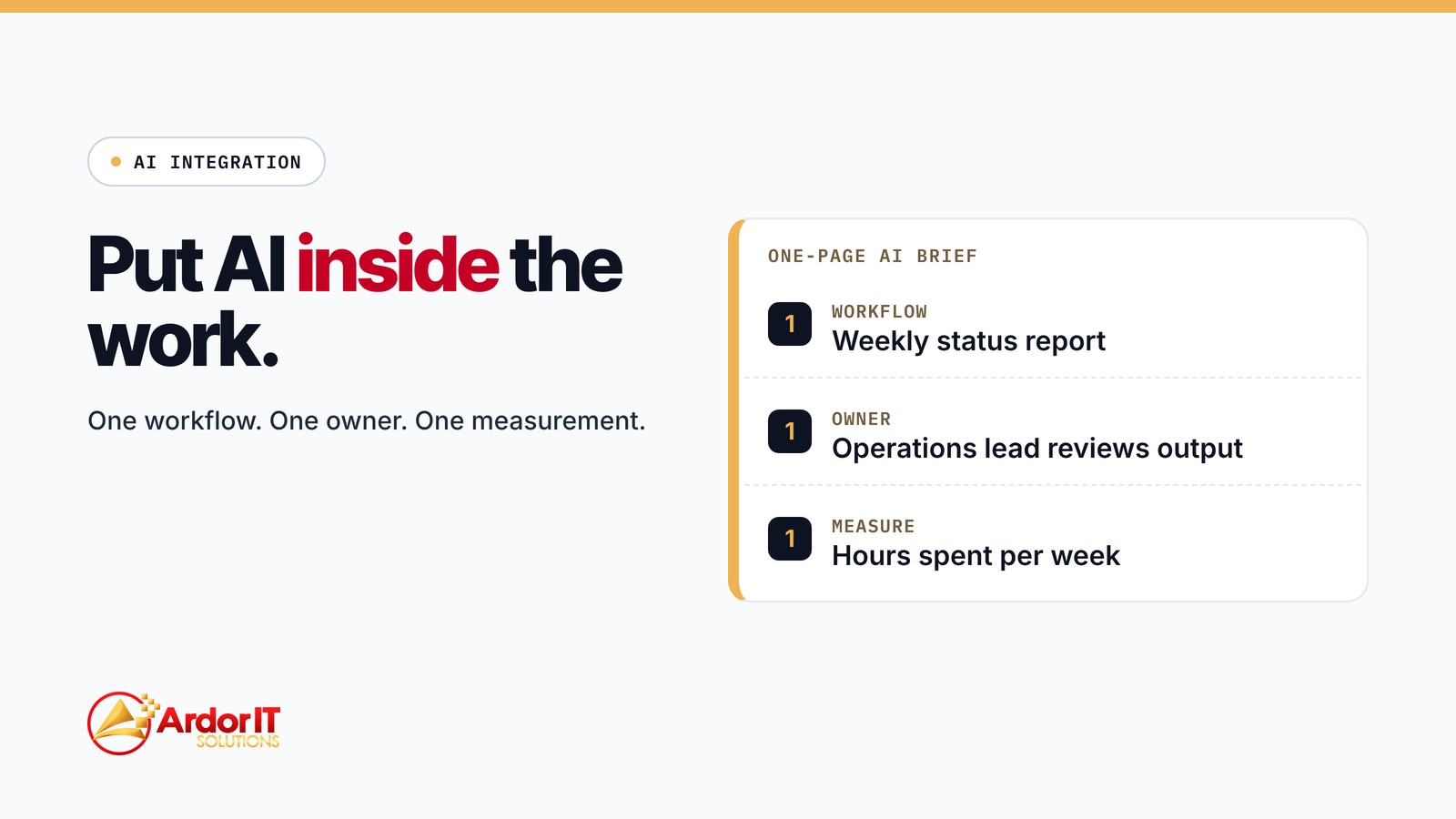
Put AI Inside the Work: Start With One Workflow, Not a Platform
“We need an AI strategy” is a reasonable goal. It’s also a hard place to start.
It’s too big to scope and too vague to measure. Teams spend months comparing platforms and drafting principles while the work that could benefit sits right in front of them: the report someone rebuilds every Monday, the inbox someone sorts every morning, the data someone re-enters every afternoon.
The AI efforts that are easiest to prove usually start small and specific. Put AI inside the work your team already does, one workflow at a time.
Why platform-first starts tend to stall
A platform decision made before anyone has identified a problem tends to create a solution looking for a use. The tool gets licensed, a pilot gets announced, and then the hard questions arrive: which data can it use, who checks the output, and what’s supposed to get better?
Starting with one workflow flips the order. You choose the problem first, so every later decision has something concrete to answer to.
Start with a task your team already dreads
Look for work that’s repetitive, rules-based, and easy to check. Where does someone copy, sort, summarize, or re-enter the same information every week? Data entry, status reports, meeting notes, and inbox triage are common candidates.
The best first workflow isn’t always the most impressive one. It’s the one where a good result is easy to recognize and a bad result is easy to catch before it causes harm.
Ask: Which task would your team happily hand off tomorrow, and how would they know if it was done right?
Check the data before the model
Even a capable model may struggle when the data the use case needs isn’t ready. In February 2025, Gartner predicted that through 2026, organizations will abandon 60% of AI projects that aren’t supported by AI-ready data (Gartner, “Lack of AI-Ready Data Puts AI Projects at Risk”). That’s a prediction, of course, not a measurement, and it’s specific to projects built on data that wasn’t ready. But the lesson still holds.
Before you pick a tool, ask whether the information your workflow needs lives somewhere AI can reach, whether it’s accurate and current enough to trust the output, and whether you’re allowed to use it for this purpose. If any answer is “I’m not sure,” start there.
Name a human owner
AI inside a workflow still needs a human accountable for it. Someone reviews the output, decides what happens when it’s wrong, and owns the workflow when the process or the data changes. Without that person, a promising pilot quietly becomes something nobody trusts.
Ask: Who reviews the output, and who owns this workflow six months from now?
Test it small before you scale it
Run the workflow with a few people on real work. Review every output at first. Fix what breaks, write down what you learned, and only then roll it out further. A small test costs little, exposes surprises early, and gives you evidence for the next decision.
Measure one thing
Pick one number that matters to the people doing the work: time spent, turnaround time, or error rate. Record it before the change and after, and report it honestly whichever way it moves. One clear measurement beats a dashboard nobody reads.
Put it on one page
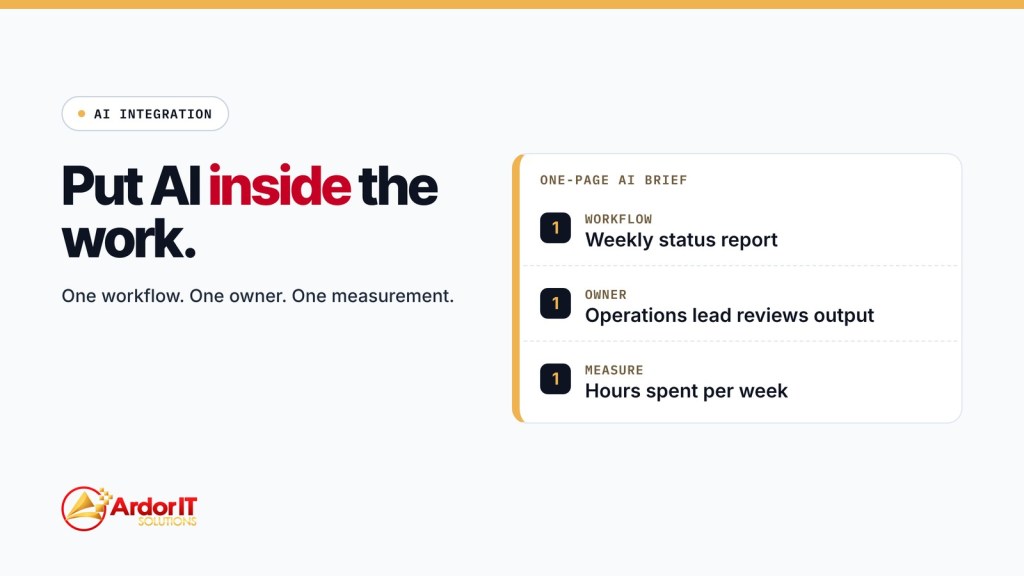
Before the first test, capture the plan in a short brief your team can see:
- Workflow. The one task you’re starting with, in a sentence.
- Data. Where the information lives, and whether it’s accurate, current, and approved for this use.
- Owner. The person who reviews the output and owns the workflow.
- Test. Who will use it, on what work, for how long.
- Measure. The one number you’ll track before and after.
- Decision. What would need to be true to expand it, adjust it, or stop.
The bottom line
One workflow. One owner. One measurement. Rinse and repeat. That’s how AI becomes part of the work instead of a project that sits beside it.
Pick one workflow this week. Write down the data it needs, who owns it, and the one number you’ll measure. Then talk with our team about integrating AI into the applications you already run.
Leave a Reply